
The Facility
The Aloha Sustainable Materials Recycling & Fertilizer Facility
A waste-recycling facility under development by Simonpietri Enterprises in the James Campbell Industrial Park in Kapolei, Hawaiʻi. Its purpose is to divert waste from the landfill and recycle as much of it as possible into useful products.
How It Works
Sort, Gasify, and Recycle Into Useful Products
We accept a variety of wastes, including construction and demolition (C&D) debris. On receipt, materials are sorted and separated, and valuable materials recycled. The organic C&D components, like clean unpainted wood, along with tropical biomass and invasive-species waste, are converted into synthesis gas using a fluidized-bed gasification system, which generates electricity to help self-power the facility.
The clean wood and green-waste ash, combined with chicken manure and other wastes, become 100% locally produced organic and potash fertilizers to support Hawaiʻi’s agriculture and improve food security. Inorganic waste sorted from the C&D debris, like concrete and window glass, becomes recycled building products. Altogether, we estimate diverting about half of Oʻahu’s C&D waste from landfills, and we keep looking for ways to divert more.
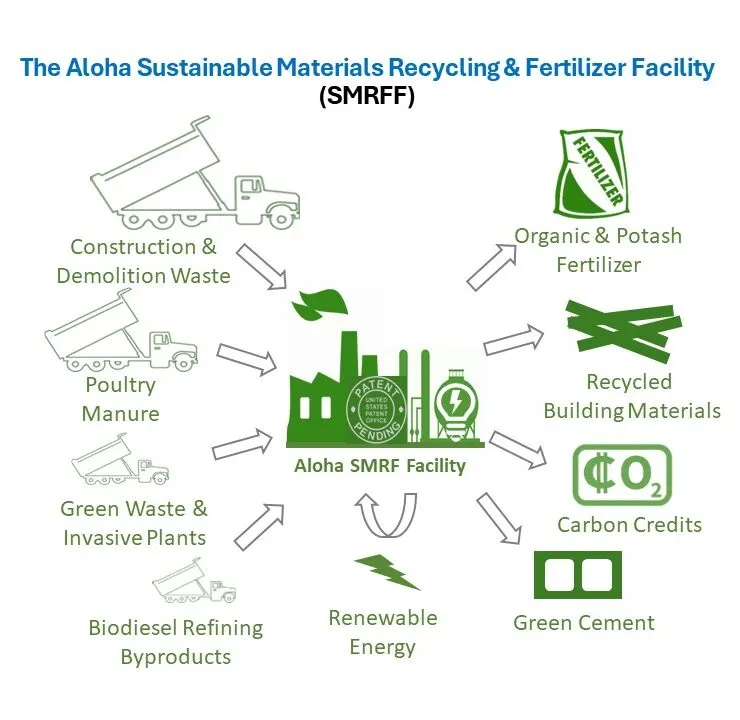
Feedstocks
The Local Wastes We Put Back to Work
Wood waste
Of the 1,500 to 2,000 tons of C&D landfilled daily, roughly 40% is wood waste that could be recycled. Wood from invasive-tree removal adds to Hawaiʻi’s total.
Mixed green waste, invasive plants & pests
Fast-growing, fire-prone invasive plants (a factor in the 2023 Lahaina wildfires) and pests like the Little Fire Ant and Coconut Rhinoceros Beetle. Gasification offers certified destruction.
Chicken manure
Manure is the single largest limiting factor for expanding egg farms on Oʻahu. We convert it into an ingredient for USDA-compliant organic and potash fertilizer.
Biodiesel potassium cake
A byproduct of biodiesel refining that currently must be landfilled in Hawaiʻi. SMRFF is designed to recover its nutrients to make potash fertilizer.
Why It Matters
The Problems We Are Addressing
Landfilled waste
Nearly 2,000 tons of C&D landfilled on Oʻahu every day, with few recycling options.
Mixed green waste
Tropical greenwaste and biomass that otherwise has nowhere to go.
Manure management
A bottleneck for local egg farms, and a costly import problem.
Invasive species
Fire-prone plants and destructive pests needing certified destruction.
Climate change
Avoided landfill methane and displaced fossil energy and fertilizer.
Environmental justice
Easing the burden on the lower-income and Native communities near the landfill.
Crop Trials and Results
Proven Against Commercial Fertilizer
With the University of Hawaiʻi’s College of Tropical Agriculture and Human Resources (CTAHR), we tested two of our recycled-material fertilizers (an Organic blend and a K-Pop potash blend) against two common commercial products and an untreated control, using a randomized block design across two short-turn crops in two locations.
In the cucumber trial (UH Waimanalo) and the pak choi trial (Pearl City Urban Garden Center), our blends produced yields comparable to organic and conventional commercial fertilizers, and performed significantly better than the untreated control.
Key takeaway: we can make fertilizer from 100% locally sourced waste that performs the same as imported commercial products. See the CTAHR 2024 slides.
The Origin Story
How We Came to Make Fertilizer
While engaging the community on making Sustainable Aviation Fuel, the question we heard most was: can you do something about invasive species, too? We won a U.S. Department of Energy research grant to use real-world invasive tropical greenwaste as a supplemental feedstock. The trials showed we could not only make fuel, but also provide 100% certified destruction of invasive plants and pests, and recycle the nutrients in the ash into organic and potash fertilizer.
Now Accepted by the State
The Final Environmental Assessment Is Published
The Final EA for the SMRFF was officially accepted by the Hawaiʻi State Department of Health and published in February 2025. Questions and comments are welcome at EA@alohasmrff.com.